


Buy and Hold May No Longer Be What Works Best for Investing

Team TRADEway • September 23, 2024

Buy and hold investing is a deeply entrenched mindset that most of today’s investors and investment managers have by default. It’s so widespread as a concept, that not many people are looking at it critically or asking if it still is working in today’s markets–or if another strategy would work better. 


But this almost universally believed mantra of “you can’t time the market” doesn’t make a lot of sense anymore because of how investing tools have shifted.


The thing is, you can take your long-term investments to cash during most volatile times in the market to avoid losing money unnecessarily. And to do this you need to be able to identify market multi-year cycles (or work with someone who can do this for you). We offer such a service with our program
AMPT - Assisted Managed Portfolios by TRADEway.


Where the Buy and Hold Strategy Originated


Buying and holding through the market’s worst days can be devastating for your portfolio. So why does almost everyone do this? 


The “buy and hold” recommendation was made famous by
John Bogle in his book The Little Book of Common Sense Investing, which was published in 2007. In it, Bogle argued that the fees that mutual fund managers charge rule out the extra returns they get from actively buying and selling in the market.


He showed you would profit more, and avoid lots of drama, by simply buying and holding index funds like the S&P and others. 


But does this argument still hold up?


Where Bogle Got Buy and Hold Wrong


Bogle made the assumption that most people aren’t going to bother to learn the skills required to get in and out of the market effectively. And he’s right, most people won’t want to bother learning how to do that.


It takes a solid stock market education to time getting in and out of the market consistently. And making a mistake with regards to timing the stock market can really cost you. 


But with the right training, tools, and expertise, timing larger market cycles is actually very doable.


In our program
AMPT, our Investment Advisor Representatives carefully monitor the market for breaks in market trends. And with our expertise (and the nimbleness that comes with not being in a mutual fund) we can get you out of the market more quickly, saving you from losing money unnecessarily. 


We also have an option within
AMPT where you can request to have our investment advisory representatives do shorter-term trades using a portion of your money (we recommend no more than 20%). This can lead to a boost in your account that you can then turn around and re-invest.


Maybe the idea of trusting someone else to get your money out of the market and knowing when to put it back in makes you nervous. That’s understandable, given how much buying and holding is preached in our society. 


Our long-term investing team are all registered investment advisors representatives. Our current roster manning the AMPT division include beloved stock trading Coaches
Geoffrey Nance, Jenny Taylor, Jared Russell, and Ben Russell, and they are all well-versed in the market’s multi-year cycles.



Market Multi-Year Cycles 


If you’re on board with the notion of someone getting in and out of the market with your long-term money, then the next thing to figure out would be when to get in and out. 


How do we do that?


It turns out, markets have multi-year cycles. These cycles are one of the most important concepts to how we approach investing in our program
AMPT


In short, you would look at longer term trends in the market. A key tenet of our
AMPT investing program is that longer term trends do not easily break.  So when they do, that is a sign for us that we want to get defensive in our allocations. 


We choose to not be in the market all the time, and sometimes that means we sit in cash while the technical charts settle into a new trend.
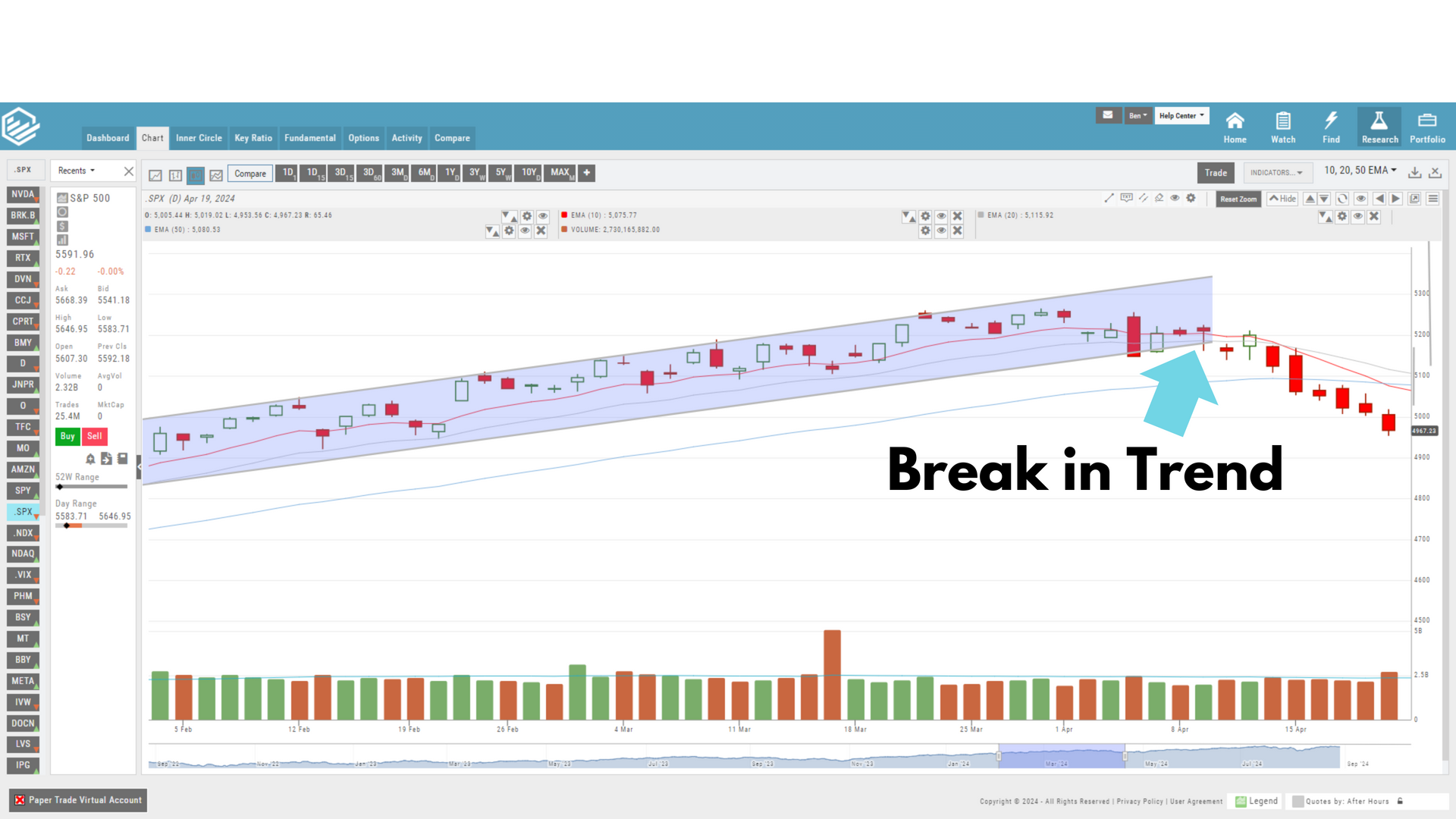
Image is from charting software Charts by TRADEway


The above chart of the SP-500 shows the normal bullish action in a trend we can easily identify, and then a break of trend.  These breaks of trend are where TRADEway believes it makes sense to get defensive and get out of the market. Both watching multi-year cycles and looking for longer term breaks in a trend are two of our main tenets in our program AMPT


Bear Markets, Bull Markets, and Squirrel Markets


Put simply, during a Bull Market, it’s generally a good time to be in the market; during a Bear Market, it’s not. And during a little something we here at TRADEway called a Squirrel Market (when the S&P is bouncing all around), it is definitely not a good time to be in. 


Our
AMPT team keeps an eye on all of these kinds of long-term trends and communicates with our AMPT clients often to keep them abreast of our current recommendations for your portfolio (we believe in open and transparent conversations with our clients which is rare in this industry). 



We also offer a range of risk profiles for long-term investing portfolios, from conservative to high-risk. High risk can yield higher returns. Our most conservative portfolio allocations are designed for those most concerned with keeping their hard-earned money intact.  Our team can help you determine the best fit for your individual needs.


The times of greatest market volatility are when the market is “squirrely” and is breaking out of a trend. During these times, we watch the technical price action of the S&P closely to guide our decisions. 


Aiming to Be in the Market on the Best Days and Out on the Worst Days


Our goal with AMPT is to minimize the risk to your long-term retirement funds. In the graph below, we see what would happen to a portfolio if you could magically miss the worst days in the market. While this kind of precision is not possible, more broad strokes of getting out of the market during a downturn are. Still, this graph can give you a sense of this principle in action:


It’s impossible to do this perfectly–to only miss the worst days, and only be in on the best days. But we can get in and out of the market following broader, more general market trends, which is what we do in AMPT.


The Main Problem With Buy and Hold


It’s true that over decades and decades, traditional “buy and holders” will see a positive return. But by staying in the market through each and every downturn, they’re leaving money on the table unnecessarily–and lots of it.  And a concern we hear with many new clients coming our way is that they do not have the TIME required to make it back if they happened to lose big on the down-side.


With a more agile long-term portfolio, you can avoid losing double-digit percentages during a downturn. And each time you successfully do this, your future returns are exponentially impacted by that extra money in the account. Wouldn’t you rather preserve your portfolio during a downturn and potentially have more in your portfolio to better take advantage of the next bull market? That is the goal.


If you’re ready to leave the “buy and hold” mentality in the past (where, let’s be honest, it should be), and if you’re wondering how much joining a program like
AMPT could impact the financial well-being of your family, book a call to learn more about our long-term investing portfolios.


Did you love this? Share it with your family & friends!

By Ben Mitchell January 19, 2026
Today we’re going to be talking about some things to consider before you buy gold or bars. We’re going to cover differences in price, liquidity and resale value. Let’s get into it! 
By Ben Mitchell January 19, 2026
Today we’re going to be talking about some things to consider before you buy gold or bars. We’re going to cover differences in price, liquidity and resale value. Let’s get into it!
By Matt Mitchell January 6, 2026
If you’re losing money trading, it’s probably because of one of these three things you need to quit doing. Many traders are addicted to more–more trades, more screens, more stress. What’s the problem with that? Sometimes it’s the fastest way to blow up your account. Hi, my name is Matt Mitchell. I’ve been trading for seven years and I absolutely love it. I’m also a Personal Strategist here at TRADEway. And today I want to share with you three things I quit doing to make more money trading.
By Matt Mitchell January 6, 2026
If you’re losing money trading, it’s probably because of one of these three things you need to quit doing. Many traders are addicted to more–more trades, more screens, more stress. What’s the problem with that? Sometimes it’s the fastest way to blow up your account. Hi, my name is Matt Mitchell. I’ve been trading for seven years and I absolutely love it. I’m also a Personal Strategist here at TRADEway. And today I want to share with you three things I quit doing to make more money trading.
By David Mitchell December 8, 2025
Did you know that 80-90% of stock traders fail? This might look like pretty terrible odds at first, but don’t let this statistic scare you. In this episode, I’m going to show you how to be the exception. Let’s look at the seven most common reasons why traders give up.
By David Mitchell December 8, 2025
Did you know that 80-90% of stock traders fail? This might look like pretty terrible odds at first, but don’t let this statistic scare you. In this episode, I’m going to show you how to be the exception. Let’s look at the seven most common reasons why traders give up. 
By David Mitchell November 24, 2025
The long-term investing industry hasn’t really changed that much in the last 50 years as far as their message goes: ”Don’t worry about bear market crashes, just stay the course…” Many people argue that the average person on the street would be way better off if they just bought the S&P 500 and held it rather than trying to buy and sell individual stocks themselves. Well, that may be absolutely true if you have zero trading skillsets. But if you do have the kind of trading skillsets that TRADEway teaches, then the old line philosophy of buy and hold isn’t the best strategy for you. In today’s episode we’re talking about some common myths that buy-and-hold-ers propagate. Let’s get into this important discussion… 
By David Mitchell November 24, 2025
The long-term investing industry hasn’t really changed that much in the last 50 years as far as their message goes: ”Don’t worry about bear market crashes, just stay the course…” Many people argue that the average person on the street would be way better off if they just bought the S&P 500 and held it rather than trying to buy and sell individual stocks themselves. Well, that may be absolutely true if you have zero trading skillsets. But if you do have the kind of trading skillsets that TRADEway teaches, then the old line philosophy of buy and hold isn’t the best strategy for you. In today’s episode we’re talking about some common myths that buy-and-hold-ers propagate. Let’s get into this important discussion…
By Dave Huber November 10, 2025
We all know that feeling… A trade is going well and you’re feeling elated anticipating taking profits. And then out of seemingly nowhere, it tanks. Man, it’s frustrating! And if this has happened to you–maybe once, maybe many times–just know, you’re not alone. You might be wondering, why did this happen? It turns out there are three common reasons why trades stop working. Once you learn these three reasons it will be easier for you to analyze your past trades and figure out what went wrong. But more importantly, once you learn these three reasons why trades stop working, you’ll be better able to prevent a trade from going south in the first place, because you’ll start to recognize the warning signs. So let’s dive in. Here are three most common reasons why people’s trades stop working.
By Dave Huber November 10, 2025
We all know that feeling… A trade is going well and you’re feeling elated anticipating taking profits. And then out of seemingly nowhere, it tanks. Man, it’s frustrating! And if this has happened to you–maybe once, maybe many times–just know, you’re not alone. You might be wondering, why did this happen? It turns out there are three common reasons why trades stop working. Once you learn these three reasons it will be easier for you to analyze your past trades and figure out what went wrong. But more importantly, once you learn these three reasons why trades stop working, you’ll be better able to prevent a trade from going south in the first place, because you’ll start to recognize the warning signs. So let’s dive in. Here are three most common reasons why people’s trades stop working.
Show More
By Ben Mitchell January 19, 2026
Today we’re going to be talking about some things to consider before you buy gold or bars. We’re going to cover differences in price, liquidity and resale value. Let’s get into it! 
By Ben Mitchell January 19, 2026
Today we’re going to be talking about some things to consider before you buy gold or bars. We’re going to cover differences in price, liquidity and resale value. Let’s get into it!
By Matt Mitchell January 6, 2026
If you’re losing money trading, it’s probably because of one of these three things you need to quit doing. Many traders are addicted to more–more trades, more screens, more stress. What’s the problem with that? Sometimes it’s the fastest way to blow up your account. Hi, my name is Matt Mitchell. I’ve been trading for seven years and I absolutely love it. I’m also a Personal Strategist here at TRADEway. And today I want to share with you three things I quit doing to make more money trading.
By Matt Mitchell January 6, 2026
If you’re losing money trading, it’s probably because of one of these three things you need to quit doing. Many traders are addicted to more–more trades, more screens, more stress. What’s the problem with that? Sometimes it’s the fastest way to blow up your account. Hi, my name is Matt Mitchell. I’ve been trading for seven years and I absolutely love it. I’m also a Personal Strategist here at TRADEway. And today I want to share with you three things I quit doing to make more money trading.
By David Mitchell December 8, 2025
Did you know that 80-90% of stock traders fail? This might look like pretty terrible odds at first, but don’t let this statistic scare you. In this episode, I’m going to show you how to be the exception. Let’s look at the seven most common reasons why traders give up.
By David Mitchell December 8, 2025
Did you know that 80-90% of stock traders fail? This might look like pretty terrible odds at first, but don’t let this statistic scare you. In this episode, I’m going to show you how to be the exception. Let’s look at the seven most common reasons why traders give up. 
By David Mitchell November 24, 2025
The long-term investing industry hasn’t really changed that much in the last 50 years as far as their message goes: ”Don’t worry about bear market crashes, just stay the course…” Many people argue that the average person on the street would be way better off if they just bought the S&P 500 and held it rather than trying to buy and sell individual stocks themselves. Well, that may be absolutely true if you have zero trading skillsets. But if you do have the kind of trading skillsets that TRADEway teaches, then the old line philosophy of buy and hold isn’t the best strategy for you. In today’s episode we’re talking about some common myths that buy-and-hold-ers propagate. Let’s get into this important discussion… 
By David Mitchell November 24, 2025
The long-term investing industry hasn’t really changed that much in the last 50 years as far as their message goes: ”Don’t worry about bear market crashes, just stay the course…” Many people argue that the average person on the street would be way better off if they just bought the S&P 500 and held it rather than trying to buy and sell individual stocks themselves. Well, that may be absolutely true if you have zero trading skillsets. But if you do have the kind of trading skillsets that TRADEway teaches, then the old line philosophy of buy and hold isn’t the best strategy for you. In today’s episode we’re talking about some common myths that buy-and-hold-ers propagate. Let’s get into this important discussion…
By Dave Huber November 10, 2025
We all know that feeling… A trade is going well and you’re feeling elated anticipating taking profits. And then out of seemingly nowhere, it tanks. Man, it’s frustrating! And if this has happened to you–maybe once, maybe many times–just know, you’re not alone. You might be wondering, why did this happen? It turns out there are three common reasons why trades stop working. Once you learn these three reasons it will be easier for you to analyze your past trades and figure out what went wrong. But more importantly, once you learn these three reasons why trades stop working, you’ll be better able to prevent a trade from going south in the first place, because you’ll start to recognize the warning signs. So let’s dive in. Here are three most common reasons why people’s trades stop working.
By Dave Huber November 10, 2025
We all know that feeling… A trade is going well and you’re feeling elated anticipating taking profits. And then out of seemingly nowhere, it tanks. Man, it’s frustrating! And if this has happened to you–maybe once, maybe many times–just know, you’re not alone. You might be wondering, why did this happen? It turns out there are three common reasons why trades stop working. Once you learn these three reasons it will be easier for you to analyze your past trades and figure out what went wrong. But more importantly, once you learn these three reasons why trades stop working, you’ll be better able to prevent a trade from going south in the first place, because you’ll start to recognize the warning signs. So let’s dive in. Here are three most common reasons why people’s trades stop working.
Show More
By Ben Mitchell January 19, 2026
Today we’re going to be talking about some things to consider before you buy gold or bars. We’re going to cover differences in price, liquidity and resale value. Let’s get into it! 
By Ben Mitchell January 19, 2026
Today we’re going to be talking about some things to consider before you buy gold or bars. We’re going to cover differences in price, liquidity and resale value. Let’s get into it!
By Matt Mitchell January 6, 2026
If you’re losing money trading, it’s probably because of one of these three things you need to quit doing. Many traders are addicted to more–more trades, more screens, more stress. What’s the problem with that? Sometimes it’s the fastest way to blow up your account. Hi, my name is Matt Mitchell. I’ve been trading for seven years and I absolutely love it. I’m also a Personal Strategist here at TRADEway. And today I want to share with you three things I quit doing to make more money trading.
By Matt Mitchell January 6, 2026
If you’re losing money trading, it’s probably because of one of these three things you need to quit doing. Many traders are addicted to more–more trades, more screens, more stress. What’s the problem with that? Sometimes it’s the fastest way to blow up your account. Hi, my name is Matt Mitchell. I’ve been trading for seven years and I absolutely love it. I’m also a Personal Strategist here at TRADEway. And today I want to share with you three things I quit doing to make more money trading.
By David Mitchell December 8, 2025
Did you know that 80-90% of stock traders fail? This might look like pretty terrible odds at first, but don’t let this statistic scare you. In this episode, I’m going to show you how to be the exception. Let’s look at the seven most common reasons why traders give up.
By David Mitchell December 8, 2025
Did you know that 80-90% of stock traders fail? This might look like pretty terrible odds at first, but don’t let this statistic scare you. In this episode, I’m going to show you how to be the exception. Let’s look at the seven most common reasons why traders give up. 
By David Mitchell November 24, 2025
The long-term investing industry hasn’t really changed that much in the last 50 years as far as their message goes: ”Don’t worry about bear market crashes, just stay the course…” Many people argue that the average person on the street would be way better off if they just bought the S&P 500 and held it rather than trying to buy and sell individual stocks themselves. Well, that may be absolutely true if you have zero trading skillsets. But if you do have the kind of trading skillsets that TRADEway teaches, then the old line philosophy of buy and hold isn’t the best strategy for you. In today’s episode we’re talking about some common myths that buy-and-hold-ers propagate. Let’s get into this important discussion… 
By David Mitchell November 24, 2025
The long-term investing industry hasn’t really changed that much in the last 50 years as far as their message goes: ”Don’t worry about bear market crashes, just stay the course…” Many people argue that the average person on the street would be way better off if they just bought the S&P 500 and held it rather than trying to buy and sell individual stocks themselves. Well, that may be absolutely true if you have zero trading skillsets. But if you do have the kind of trading skillsets that TRADEway teaches, then the old line philosophy of buy and hold isn’t the best strategy for you. In today’s episode we’re talking about some common myths that buy-and-hold-ers propagate. Let’s get into this important discussion…
By Dave Huber November 10, 2025
We all know that feeling… A trade is going well and you’re feeling elated anticipating taking profits. And then out of seemingly nowhere, it tanks. Man, it’s frustrating! And if this has happened to you–maybe once, maybe many times–just know, you’re not alone. You might be wondering, why did this happen? It turns out there are three common reasons why trades stop working. Once you learn these three reasons it will be easier for you to analyze your past trades and figure out what went wrong. But more importantly, once you learn these three reasons why trades stop working, you’ll be better able to prevent a trade from going south in the first place, because you’ll start to recognize the warning signs. So let’s dive in. Here are three most common reasons why people’s trades stop working.
By Dave Huber November 10, 2025
We all know that feeling… A trade is going well and you’re feeling elated anticipating taking profits. And then out of seemingly nowhere, it tanks. Man, it’s frustrating! And if this has happened to you–maybe once, maybe many times–just know, you’re not alone. You might be wondering, why did this happen? It turns out there are three common reasons why trades stop working. Once you learn these three reasons it will be easier for you to analyze your past trades and figure out what went wrong. But more importantly, once you learn these three reasons why trades stop working, you’ll be better able to prevent a trade from going south in the first place, because you’ll start to recognize the warning signs. So let’s dive in. Here are three most common reasons why people’s trades stop working.
Show More
By Ben Mitchell January 19, 2026
Today we’re going to be talking about some things to consider before you buy gold or bars. We’re going to cover differences in price, liquidity and resale value. Let’s get into it! 
By Ben Mitchell January 19, 2026
Today we’re going to be talking about some things to consider before you buy gold or bars. We’re going to cover differences in price, liquidity and resale value. Let’s get into it!
By Matt Mitchell January 6, 2026
If you’re losing money trading, it’s probably because of one of these three things you need to quit doing. Many traders are addicted to more–more trades, more screens, more stress. What’s the problem with that? Sometimes it’s the fastest way to blow up your account. Hi, my name is Matt Mitchell. I’ve been trading for seven years and I absolutely love it. I’m also a Personal Strategist here at TRADEway. And today I want to share with you three things I quit doing to make more money trading.
By Matt Mitchell January 6, 2026
If you’re losing money trading, it’s probably because of one of these three things you need to quit doing. Many traders are addicted to more–more trades, more screens, more stress. What’s the problem with that? Sometimes it’s the fastest way to blow up your account. Hi, my name is Matt Mitchell. I’ve been trading for seven years and I absolutely love it. I’m also a Personal Strategist here at TRADEway. And today I want to share with you three things I quit doing to make more money trading.
By David Mitchell December 8, 2025
Did you know that 80-90% of stock traders fail? This might look like pretty terrible odds at first, but don’t let this statistic scare you. In this episode, I’m going to show you how to be the exception. Let’s look at the seven most common reasons why traders give up.
By David Mitchell December 8, 2025
Did you know that 80-90% of stock traders fail? This might look like pretty terrible odds at first, but don’t let this statistic scare you. In this episode, I’m going to show you how to be the exception. Let’s look at the seven most common reasons why traders give up. 
By David Mitchell November 24, 2025
The long-term investing industry hasn’t really changed that much in the last 50 years as far as their message goes: ”Don’t worry about bear market crashes, just stay the course…” Many people argue that the average person on the street would be way better off if they just bought the S&P 500 and held it rather than trying to buy and sell individual stocks themselves. Well, that may be absolutely true if you have zero trading skillsets. But if you do have the kind of trading skillsets that TRADEway teaches, then the old line philosophy of buy and hold isn’t the best strategy for you. In today’s episode we’re talking about some common myths that buy-and-hold-ers propagate. Let’s get into this important discussion… 
By David Mitchell November 24, 2025
The long-term investing industry hasn’t really changed that much in the last 50 years as far as their message goes: ”Don’t worry about bear market crashes, just stay the course…” Many people argue that the average person on the street would be way better off if they just bought the S&P 500 and held it rather than trying to buy and sell individual stocks themselves. Well, that may be absolutely true if you have zero trading skillsets. But if you do have the kind of trading skillsets that TRADEway teaches, then the old line philosophy of buy and hold isn’t the best strategy for you. In today’s episode we’re talking about some common myths that buy-and-hold-ers propagate. Let’s get into this important discussion…
By Dave Huber November 10, 2025
We all know that feeling… A trade is going well and you’re feeling elated anticipating taking profits. And then out of seemingly nowhere, it tanks. Man, it’s frustrating! And if this has happened to you–maybe once, maybe many times–just know, you’re not alone. You might be wondering, why did this happen? It turns out there are three common reasons why trades stop working. Once you learn these three reasons it will be easier for you to analyze your past trades and figure out what went wrong. But more importantly, once you learn these three reasons why trades stop working, you’ll be better able to prevent a trade from going south in the first place, because you’ll start to recognize the warning signs. So let’s dive in. Here are three most common reasons why people’s trades stop working.
By Dave Huber November 10, 2025
We all know that feeling… A trade is going well and you’re feeling elated anticipating taking profits. And then out of seemingly nowhere, it tanks. Man, it’s frustrating! And if this has happened to you–maybe once, maybe many times–just know, you’re not alone. You might be wondering, why did this happen? It turns out there are three common reasons why trades stop working. Once you learn these three reasons it will be easier for you to analyze your past trades and figure out what went wrong. But more importantly, once you learn these three reasons why trades stop working, you’ll be better able to prevent a trade from going south in the first place, because you’ll start to recognize the warning signs. So let’s dive in. Here are three most common reasons why people’s trades stop working.
Show More