Retirement 101: A Comprehensive Guide to Your Financial Future

Planning for retirement is one of the most crucial steps you can take towards securing your financial future. Whether you’re just starting your career or nearing the end of your working years, understanding the nuances of retirement planning can make a significant difference in your quality of life post-retirement.

In this post, we examine Retirement 101 and the various types of retirement accounts and how TRADEway can assist you in planning for your retirement. By empowering yourself with knowledge and strategies, you can navigate the complexities of retirement planning with confidence and pave the way for a potentially secure and fulfilling retirement.

Why Are There So Many Types of Retirement Accounts?

Employer-Sponsored Accounts

  • 401(k): A common employer-sponsored retirement plan
  • 403(b): Designed for employees of public schools and certain tax-exempt organizations
  • Thrift Savings Plans (TSPs): Available to federal employees and members of the uniformed services
  • Pensions: Traditional retirement plans offering fixed monthly payments

If you work for a company that offers a retirement package, there’s not much choice you have in what kind of option you can choose and select. It’s going to be what your employer is offering and you have the choice whether you want to participate in it or not.

In this example, we’re going to be talking about a 401k, which would be considered a defined contribution plan versus what would be a defined benefit plan.

A defined benefit plan would be like a pension plan that pays out a certain amount each month. You can receive a percentage of your highest grossing salary upon your retirement.

A 401k plan is defined by how much has been contributed into it. You would personally make pre-tax or post-tax contributions to your retirement account from your paycheck. Additionally, many employers will also match your contribution up to three to five percent.

Now if you’re putting in post-tax contributions to your 401K, meaning you’ve paid the taxes up before depositing to your account, your employer may contribute pre-tax, meaning you’re going to have to pay taxes on the earnings from that when you take the distribution.


Individual Retirement Accounts (IRAs)

  • Traditional IRA: Contributions may be tax-deductible, with taxes paid upon withdrawal
  • Roth IRA: Contributions are made with after-tax dollars, allowing for tax-free withdrawals in retirement

So what if your employer doesn’t offer retirement benefits or maybe you’re self employed?

There are a few options.

A traditional IRA allows you to contribute the pre-tax money, so that could potentially reduce the tax liability for you that year, by reducing your earnings for that year. There’s a max contribution of $7,000 ($8,000 if you’re 50 or older). Taxes are paid when you take distributions out.

These limits get adjusted every year. The information in this post contains the current 2024 information.

The next one is the Roth IRA. The interesting thing about your Roth IRA is that you’re contributing the post-tax money, meaning you’ve already earned the income, you’ve paid taxes on it, you can contribute the $7,000 ($8,000 if you’re older than 50),  but everything that would grow in that account is actually going to be tax free.

So it’s tax free upon distribution and there are no required minimum distributions. Now there are eligibility restrictions when it comes to income. With higher earners it phases down or you may not be able to contribute to this at all, which is different than the Roth 401k, which you can continue to contribute to.

Note: If you are in a higher tax bracket right now, the more you can save, and invest it tax deferred into your retirement accounts, that amount is deductible from your gross annual income. Consult with your CPA or tax professional for more information.

How Can Tradeway Help You Prepare For Retirement?

At TRADEway, we care about you, we care about your family, and we’re trying to provide you with support for some of the existing retirement alternatives. You don’t have to go through a financial crisis with a buy and hold mentality

Maybe you would like some different options that are not available in your traditional 401k programs because of the limitations that exist in those programs.

If we go into a recession, on average, the bear markets are at least 34 percent down and you don’t want to see a 34% decline in your portfolio.

Can TRADEway help manage your portfolio for you in such a way that it helps protect your funds during those significant downturns?


Imagine this: there is a hurricane coming. What do you do?  You get prepared for the hurricane 
before the hurricane hits.  We know these economic hurricanes come. So, if you were prepared for the economic hurricane, you boarded up your portfolio’s windows, and you will survive through that economic hurricane with minimal scratches. You know, you had a little bit of damage in the yard, but your house was fine and everything came through with just very nominal damage.


That’s what we do at 
Assisted Managed Portfolios by TRADEway – AMPT.


As licensed traders – Investment Advisory Representative (IAR), the AMPT team can  get in and out of positions as the market changes. And it’s known as discretionary trade authority. 

This is a big advantage of working with AMPT, because traditional financial advisors don’t have or don’t want discretionary trade authority. They’re going to meet with you once every six months or a year, or in the case of your 401k, probably never.


That’s not the way the AMPT program works. You give AMPT the discretion to change your allocations at any moment. 

AMPT Portfolio Management Options

Assisted Managed Portfolios by TRADEway – Advanced Investment Management (AIM )

TRADEway created a program that mirrors that philosophy and it’s called AIM, Advanced Investment Management, and it leverages the biblical concepts from Ecclesiastes and from the book of Ezekiel to create a diversified portfolio That’s designed for more of a long-term approach with more diversification and more safety, and our team does that for you.

We are in and out of ETFs that mimic the sectors of the economy. We’ll change the allocations when we’re not confident of what the market’s doing, we’ll pull back on allocations. We’ll be more in cash getting that current 4.287 percent. When we’re confident in a specific sector, we’ll put more money into that sector as opposed to other sectors.

And it takes just a few clicks of the button for our team to invest those for you. And it’s a pretty powerful way for us to do things that your 401k is not going to do. Most of the time, they’re going to leverage mutual funds, while you don’t even know what those funds are or how they’re invested. With us, we’re going to be in and out of those positions based on what we see happening inside the economy.

Assisted Managed Portfolios by TRADEway – Ultra Portfolio (UP)

The Ultra Portfolio program is active trading with a small portion of your money.

The Ultra Portfolio is more focused on short term trades. We get in and get out of trades and try to make a little higher returns on a smaller portion of your money by taking more risk.

In this portfolio, we utilize index-based financial instruments, ETFs, stocks and stock options, and trade based upon market cycles and short-term time frames. Let TRADEway help you with managing a portion of your funds (more aggressively) with a trader’s mindset!

At TRADEway, our AMPT team is dedicated to helping you navigate the intricacies of retirement planning and portfolio management. With our team, you can explore a range of options tailored to your specific financial goals and risk tolerance. Whether you’re looking to diversify your investments, maximize your savings, or simply gain a deeper understanding of your retirement strategy, our team is here to provide you with personalized insights and guidance.

Don’t leave your financial future to chance—contact the TRADEway AMPT team today to learn how we can assist you in preparing your portfolio for retirement. Get started on your journey to financial peace of mind by reaching out to us now.


Silver vs. Gold

If you’re ready to invest in precious metals, should you be buying silver, not gold? Today, we’re going to be addressing the question, and how to know if that’s best for you and your family.


It is important to understand the difference between these two precious metals–silver and gold–and why you might favor one over the other. Number one, the total supply of new silver each year is close to 1 
billion ounces while gold’s annual supply is around 83 million ounces. 


This makes it 
seem like the silver market is a lot bigger than gold’s, but it’s just the opposite because of the huge difference in their price! Silver’s lower price makes the value of the annual supply much smaller than gold’s, and this also explains why silver is so much more volatile than gold.

So, let’s examine silver vs. gold, so that you can determine what’s best for your precious metals investing.

Silver is Better for Trade Than Gold, But Gold is Easier to Transport

Silver is better for physical trade as silver is easier to acquire than gold. You can get more metal for your dollar with silver.


Gold, however, is generally more 
conservative; it’s a solid hedge used for protecting your purchasing power and investments. Gold is better for saving than for trade, but gold is also easier to store and to transport, because of how much less of it you need due to its value.


Additionally, most silver is a lot less dense than gold. In other words, pure silver is 
84 percent larger in volume than pure gold. This means that silver takes up as much as 128 times more space than gold for the same dollar amount. 

Keep this in mind as well: silver coins and bars must be stored in a dry place with no exposure to the elements, since silver will also eventually tarnish. Pure gold does not do that!

It takes a lot more strategizing and physical storage space to store silver over gold.

Silver Prices are Volatile While Gold is More Steady

It takes only a relatively small amount of money to have a greater impact on silver’s price. As a result, silver will rise and fall more than gold, which can make the silver spot price chart look pretty scary sometimes–that’s the volatility I mentioned above!

Another interesting factor is that Governments are increasing their gold reserves but they are simultaneously decreasing their silver reserves (or at least not doing anything with them). This difference may not seem like something to be worried about right now, but it’s a very significant kind of “behind the scenes” development that could drastically alter the prices of metals in the future.

For example, Governments and other institutions used to hold a whole lot of silver inventories. Today, however, most of them no longer have any stockpiles of the metal because real silver is no longer used to mint circulating coins like it used to be. Only a few countries still warehouse silver, but the amount is in stark contrast with the large increases in gold that central banks have accumulated in official reserves over the last few decades.

But while this source of demand for gold isn’t present for silver, it does put the silver market in an interesting situation because if the need for physical silver were to suddenly appear–maybe because of a particular type of financial crisis, or spike in silver demand–governments won’t be able to meet those needs with their current stockpiles.

This has the potential to lead to higher silver prices in the future, and one more possible contributor to silver’s “upside potential” that analysts have been talking about for decades.

Silver Has More Industrial Demand Than Gold

Because silver is a considerably more useful metal than gold, there are some implications here that could play a big part in your decision to accumulate silver over gold. Even though gold is an undeniably excellent store of value, gold is used in relatively few industries outside of jewelry and investing.

According to statistics released by the World Gold Council, on average, less than 8 percent of gold production around the world is actually used in technological industries. Silver, on the other hand, is used in a huge variety of different industries and technologies, which all play a very important role in our everyday lives.

Around half of all silver produced in the world is sourced for the purpose of production in technology and appliances that cover a wide range of needs.

Some examples of where silver is used in production:

  • Radiology
  • Photography
  • Chips and circuit boards
  • Explosives
  • Water purification systems
  • Medical field and medical field technology
  • Solar energy

Given the fact that it’s almost certain that the renewable energy sector will continue to grow and increase in demand itself, silver would therefore play a bigger and bigger role in that industry, and its price could increase potentially as a result of it.Deciding which metal is best for you and your family is totally up to you and the personal concerns that you have for the future!However, knowing a few of these details can help you factor in more variables to your risk management and could potentially save you money, time, and will prepare you for the logistical side of planning as well.

Now, my hope is that this information will help you and help you better understand the differences between silver and gold precious metals and how one may be better for your family over the other.

If this topic interests you and you want to learn more about the history of money and how society has evolved from using precious metals to using digital fiat currency, I would love to invite you to check out my online course, “Barter to Currency.”

Understanding the history of money can be the key to having financial confidence as money evolves over time and is available through TRADEway’s Barter to Currency course.

Watch this video for more information:

Buy and Hold May No Longer Be What Works Best for Investing

Buy and hold investing is a deeply entrenched mindset that most of today’s investors and investment managers have by default. It’s so widespread as a concept, that not many people are looking at it critically or asking if it still is working in today’s markets–or if another strategy would work better.

But this almost universally believed mantra of “you can’t time the market” doesn’t make a lot of sense anymore because of how investing tools have shifted.


The thing is, you can take your long-term investments to cash during most volatile times in the market to avoid losing money unnecessarily. And to do this you need to be able to identify market multi-year cycles (or work with someone who can do this for you). We offer such a service with our program 
AMPT – Assisted Managed Portfolios by TRADEway.

Where the Buy and Hold Strategy Originated

Buying and holding through the market’s worst days can be devastating for your portfolio. So why does almost everyone do this?


The “buy and hold” recommendation was made famous by 
John Bogle in his book The Little Book of Common Sense Investingwhich was published in 2007. In it, Bogle argued that the fees that mutual fund managers charge rule out the extra returns they get from actively buying and selling in the market.

He showed you would profit more, and avoid lots of drama, by simply buying and holding index funds like the S&P and others.

But does this argument still hold up?

Where Bogle Got Buy and Hold Wrong

Bogle made the assumption that most people aren’t going to bother to learn the skills required to get in and out of the market effectively. And he’s right, most people won’t want to bother learning how to do that.

It takes a solid stock market education to time getting in and out of the market consistently. And making a mistake with regards to timing the stock market can really cost you.

But with the right training, tools, and expertise, timing larger market cycles is actually very doable.


In our program 
AMPT, our Investment Advisor Representatives carefully monitor the market for breaks in market trends. And with our expertise (and the nimbleness that comes with not being in a mutual fund) we can get you out of the market more quickly, saving you from losing money unnecessarily.


We also have an option within 
AMPT where you can request to have our investment advisory representatives do shorter-term trades using a portion of your money (we recommend no more than 20%). This can lead to a boost in your account that you can then turn around and re-invest.

Maybe the idea of trusting someone else to get your money out of the market and knowing when to put it back in makes you nervous. That’s understandable, given how much buying and holding is preached in our society.


Our long-term investing team are all registered investment advisors representatives. Our current roster manning the AMPT division include beloved stock trading Coaches 
Geoffrey NanceJenny TaylorJared Russell, and Ben Russell, and they are all well-versed in the market’s multi-year cycles.

Market Multi-Year Cycles

If you’re on board with the notion of someone getting in and out of the market with your long-term money, then the next thing to figure out would be when to get in and out.

How do we do that?


It turns out, markets have multi-year cycles. These cycles are one of the most important concepts to how we approach investing in our program 
AMPT.


In short, you would look at longer term trends in the market. A key tenet of our 
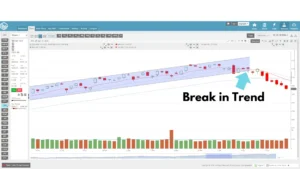
AMPT investing program is that longer term trends do not easily break.  So when they do, that is a sign for us that we want to get defensive in our allocations. 

We choose to not be in the market all the time, and sometimes that means we sit in cash while the technical charts settle into a new trend

The above chart of the SP-500 shows the normal bullish action in a trend we can easily identify, and then a break of trend.  These breaks of trend are where TRADEway believes it makes sense to get defensive and get out of the market. Both watching multi-year cycles and looking for longer term breaks in a trend are two of our main tenets in our program AMPT.

Bear Markets, Bull Markets, and Squirrel Markets

Put simply, during a Bull Market, it’s generally a good time to be in the market; during a Bear Market, it’s not. And during a little something we here at TRADEway called a Squirrel Market (when the S&P is bouncing all around), it is definitely not a good time to be in.


Our 
AMPT team keeps an eye on all of these kinds of long-term trends and communicates with our AMPT clients often to keep them abreast of our current recommendations for your portfolio (we believe in open and transparent conversations with our clients which is rare in this industry).

We also offer a range of risk profiles for long-term investing portfolios, from conservative to high-risk. High risk can yield higher returns. Our most conservative portfolio allocations are designed for those most concerned with keeping their hard-earned money intact.  Our team can help you determine the best fit for your individual needs.

The times of greatest market volatility are when the market is “squirrely” and is breaking out of a trend. During these times, we watch the technical price action of the S&P closely to guide our decisions.

Aiming to Be in the Market on the Best Days and Out on the Worst Days

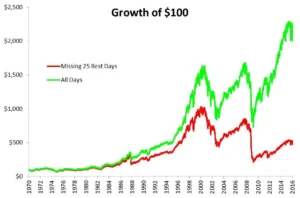
Our goal with AMPT is to minimize the risk to your long-term retirement funds. In the graph below, we see what would happen to a portfolio if you could magically miss the worst days in the market. While this kind of precision is not possible, more broad strokes of getting out of the market during a downturn are. Still, this graph can give you a sense of this principle in action:

It’s impossible to do this perfectly–to only miss the worst days, and only be in on the best days. But we can get in and out of the market following broader, more general market trends, which is what we do in AMPT.

The Main Problem With Buy and Hold

It’s true that over decades and decades, traditional “buy and holders” will see a positive return. But by staying in the market through each and every downturn, they’re leaving money on the table unnecessarily–and lots of it.  And a concern we hear with many new clients coming our way is that they do not have the TIME required to make it back if they happened to lose big on the down-side.

With a more agile long-term portfolio, you can avoid losing double-digit percentages during a downturn. And each time you successfully do this, your future returns are exponentially impacted by that extra money in the account. Wouldn’t you rather preserve your portfolio during a downturn and potentially have more in your portfolio to better take advantage of the next bull market? That is the goal.


If you’re ready to leave the “buy and hold” mentality in the past (where, let’s be honest, it should be), and if you’re wondering how much joining a program like 
AMPT could impact the financial well-being of your family, book a call to learn more about our long-term investing portfolios.

Should Christians Invest in the Stock Market

Is Trading or Investing in the Stock Market Sinful?

Christians interested in investing and stock trading often wonder if the stock market itself is sinful. And while lots of gambling has certainly taken place in the stock market, that’s absolutely not what the stock market is for.


Let’s break this down. Is the stock market itself sinful? Looking at its origins will give us some important clues. On May 17th 1792, a group of stock brokers and merchants signed the 
Buttonwood Agreement plan outside of 68 wall street under a Buttonwood tree in New York

The New York Stock Exchange Building Exterior. Photo credit: Arpan Parikh.

The Buttonwood Agreement was an attempt to put an end to shady and chaotic practices in stock trading by providing a basic structure and general framework for future trading. It created a centralized exchange that we now know as the New York Stock Exchange. The agreement helped to create a free market system where anyone can have access to the buying and selling of publicly traded securities.

And it also provided transparency to keep average traders, like you and me, safe from the malpractices of dishonest people. So the stock market is actually a place designed to lower risk, which means it’s quite opposite to the idea of gambling. Since its inception, it was intended for legitimate business purposes, and it’s still used for that to this day. The stock market is meant to bolster and improve our economy, and it does just that.

Could it still be used for gambling? Of course. Just like you can gamble in anything in life.


To keep it from being gambling, we just need to get educated about it. Our entire 
stock trading education is based around teaching Christians to trade in the stock market biblically. TRADEway was founded by David Mitchell, a Christian stock trader. TRADEway began with David teaching stock trading to his fellow church members, and it’s only grown from there. So from its inception, our stock trading education has been rooted in what it means to be a Christian stock trader, and the extra responsibilities that come with that.


We take our economic principles that we teach our students to become better stock traders straight from the Bible. As David says in his podcast 
The Word on Investing, “The Bible is a practical book.” 

Using Ecclesiastes to Understand Investing and Trading

If you go to Ecclesiastes chapter 11, you’ll see a lot of biblical business principles, and believe it or not, many of these same principles are found in the stock market. Ecclesiastes 11:1 says, “Cast thy bread upon the waters for thou shalt find it after many days.”

This may seem like a weird verse at first because it doesn’t seem like it’s talking about money, but that’s because it’s an analogy. The idea of casting bread upon the water carries with it an element of risk. If you throw bread on the water, you’re giving up your food, but it also carries with it the idea of getting a return. When you throw your food into the water, you attract fish. If there are no fish in the area, it may sit at the bottom of the water for a few days, but eventually fish might be drawn to it and you would have the potential for more food.

Similarly, if you buy stocks, you are risking your money but it’s not a get rich quick scheme. You might see some immediate results, but often it’s a process that takes many days or even months before you’ll see a return.


Let’s look at the next verse. 
Ecclesiastes 11:2 says, “Give a portion to seven and also to eight, for thou knowest not what evil shall be upon the earth.

This shows the idea of diversification. Take your money and invest it in several opportunities. Why? Because you don’t know what bad things are going to happen. And if you have all your eggs in one basket, you might lose them all. So for this reason, Solomon, in all his wisdom, says that you should diversify. In the stock market, we see the use of diversification all the time.

You Won’t Have Control Over the Stock Market–And the Bible Can Help You With That

Traders can find it difficult psychologically to engage with the stock market because it’s always changing. Until you learn patterns to look for, it can be hard to feel like there’s any solid ground. This lack of control can be stressful. And the Bible can help you navigate that.

Ecclesiastes 11:3 says, “If the clouds be full of rain, they empty themselves upon the earth: And if the tree fall toward the south, or toward the north, in the place where the tree falleth, there it shall be.” This verse is here to remind us that we are not in control. It’s God who’s in control.

One of the things people hate most about the stock market is that they can’t control it. But we never really have control in life. God does. Once you can understand that and let go of trying to control the market, you can start to see what it’s doing more clearly, making you a better trader.

The next verse says, “He that observeth the wind shall not sow; and he that regardeth the clouds shall not reap.” The Holy Spirit in His infinite wisdom is speaking through the pen of the wisest king to ever live, King Solomon. And in this verse, He knows that He has just told us we don’t have control, and so now he needs to help us deal with our emotions. The two emotions he chooses to address happen to be the two driving forces of the stock market: Fear and greed.

The Bible on Overcoming Fear & Greed So You Can Place Better Trades

The farmer that observes the wind will be too fearful to sow his seed. He’ll worry that he might have his seed blown away and lost to the wind. So he’ll never have a harvest. People often sell stocks too early or never buy stocks at all for fear of loss. They’re like the ones who observe the wind.

Then you have the one that regardeth the clouds. He’s the farmer who did sow his seed and he’s about to harvest his crops. When he sees rain clouds, he says to himself, “Hmm, maybe I should wait and let the clouds water these crops so they’ll get bigger before I harvest.” He’s the one that gets greedy in the stock market.

This looks like the guy who buys the stock and never sells it because he thinks, oh, it’ll keep going up. Sometimes he finds that he’ll get washed out while hoping for more. When approaching the stock market, we should neither be fearful nor greedy. Why? Because God is our provider and it’s His money to begin with.

The Bible on Getting to Work, Investing in Multiple Things & Taking Advantage of Opportunities

We cannot earn one penny more than we’re supposed to. So don’t worry about it. Just do the best you can and watch what God does with it. Ecclesiastes 11:5 says, “As thou knowest not what is the way of the spirit, nor how the bones do grow in the womb of her that is with child: even so thou knowest not the works of God who maketh all.”

I love that this chapter starts off talking about money, and quickly turns to a discussion about trusting God. This verse shows us it’s God who’s in control. So what do we do with that? We do what the next verse says. Verse 6 says, “In the morning sow thy seed, and in the evening withhold not thine hand: for thou knowest not whether shall prosper, either this or that, or whether they both shall be alike good.”

In other words, get to work. Invest in multiple things. Take advantage of opportunities. You’re really not in control of your future anyway. So just do the best you can with what God gave you and wait and see what God prospers.

But wait, there’s more…

The Book of Matthew Encourages Us to Invest

In Matthew 25, we have the Parable of the Talents. Remember the third servant who buried his talent? What did the master say to him? He said, “Thou oughtest therefore to have put my money to the exchangers, and then at my coming I should have received mine own with usury.”


The master (who represents God) is saying, 
If you’re not going to invest on your own, at least give it to someone who will.

For some, this is the only excuse they need to not learn to trade themselves. But letting someone else trade for you can have its own set of risks. And it sounds to me like God is making that out to be the least you should do.

So Should You as a Christian Trade in the Stock Market?

Maybe you’ve considered learning to trade yourself. This brings us to the question at hand. Should you as a Christians trade in the stock market? That depends. If you’re looking for a get rich quick scheme, then the stock market is probably not for you.

But if you can follow a very particular set of rules, put your trust in God rather than in money, lay aside fear and greed and make educated decisions with your money, then stock trading could give you the potential to change your life.

If you want to learn more about our Biblically based stock trading education, click the button below to schedule a call with Team TRADEway to learn more about how you can get started.

How to Protect Your Capital Over $250k

When your savings in any one of your accounts reaches over $250k, it becomes just as important to protect it as it is to continue to grow it. Most people know how to grow their money through investments, but most people don’t know how to protect it from a major market crash or a bank failure. If your capital is over $250k in any one of your accounts, here’s how to protect it.

Stability of the Financial System

We can’t talk about the stability of your individual investment accounts without talking about the stability of our financial system. You and I are blessed to be a part of the United States economy. Normally our economy is extremely stable.

As stable as our economy has been historically, however, it’s not always stable. There are times of instability.

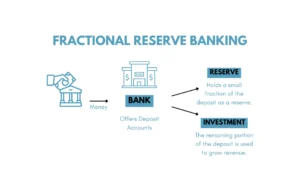
When the economy feels unpredictable, the people in charge begin to worry about our banks. Why would they worry about banks? Because when the economy becomes unpredictable, one very human reaction is to want to take your money out of the bank. This knee-jerk reaction to instability is a big potential problem because of something called fractional reserves.

When you deposit your money into your bank accounts, it doesn’t actually just sit there waiting for you to come take it out again. The bank invests some of it and also loans some of it out.

Because of this, if we were to all ask for our money back at the same time, much of that money wouldn’t be there in liquid form to take out.

This is why we have the FDIC.

Understanding FDIC Insurance

The FDIC, or the Federal Deposit Insurance Corporation, exists to help to protect your money. The FDIC helps oversee and safeguard bank deposits. It’s basically insurance on your account.

The FDIC guarantees that you can get your hands on up to $250,000 of your money. But what if you have more than that?

For example, if I deposit $500,000 into one of my accounts, am I protected up to that amount of money? Nope, only up to half. So if my account is greater than that $250,000, I probably need to start thinking a little differently.

Why? Well, because sometimes banks fail. You think it could never happen to you, but the thing is, it could. Some of these recent notable bank failures include Silicon Valley Bank, Signature Bank, and First Republic Citizens Bank. Banks do fail.

Federal Reserve Role and Impact 

What is the Federal Reserve and what is its role? How did it come to be? The role of the Federal Reserve is mandated by Congress. Congress gives the federal reserve its authority.

The Federal Reserve has three mandates:

  1. To maximize employment
  2. To stabilize prices
  3. To moderate long-term interest rates

That’s what the Congress has chartered the Fed to do. Their duty is to promote the stability of the United States economy.

The Fed is trying to avoid and prevent systemic-wide risk. And one of the threats to our economic stability that they take very seriously is runaway inflation. When prices inflate too quickly, that creates systemic problems that could become catastrophic for the economy.

The only real tool that the Fed has to keep our economy stable is control over interest rates. So their primary hammer to be able to control inflation is increasing interest rates. Unfortunately, artificially raising interest rates can cause other unintended consequences, so it’s by no means a perfect system. From history we can tell that typically the Federal Reserve has had a relatively hard time keeping the economy balanced because of the way the economy functions.

Despite fluctuating economic times, there are three powerful ways you can protect your capital over $250,000.

Here’s how we recommend you protect your capital over $250,000.

  1. Use brokers that offer enhanced insurance
  2. Split deposits across multiple banks
  3. Use different types of accounts

HOW Assisted Managed Portfolios by TRADEway (AMPT) CAN HELP

For our long-term investing program, AMPT, we’ve partnered with broker Interactive Brokers. One of the reasons we partner with Interactive Brokers is that they have enhanced FDIC insurance. They are part of something called the Enhanced FDIC Insured Bank Deposit Sweep Program. So joining AMPT increases your FDIC insurance to $2.5 million dollars.

Have you ever asked your financial advisor to go to cash? Most of the time when I ask this question, people don’t even know they can. People don’t even know that they can ask their financial advisor to go to cash.

But you are the owner of those funds. That’s your money. You should be working with a financial advisor who’s willing to help you to protect your assets.

How different could your portfolio look if it avoided drastic declines during major recessions? This is why the Founder and CEO of TRADEway, David Mitchell, created our long-term investing program AMPT (Assisted Managed Portfolios by TRADEway).

AMPT is built on the philosophy that avoiding periods of strong market declines could drastically affect your ability to build the kind of wealth that lasts generations. That’s what our AMPT program is built to do.

David Mitchell, our Founder, takes Biblical concepts and he uses those concepts to create the foundation of everything that we do here at TRADEway.

Another reason we have partnered with Interactive Brokers for our long-term investing program AMPT is that you earn 4.83% on cash in qualified accounts. So you are able to make 4.83% even while your money is so-called “waiting on the sidelines” for the market to get better again.

If your account is invested during an economic decline, you might see it reduced by 20%, 30%, even 40% as many people’s accounts did in 2007-2008.

Our AMPT team is here to help you avoid those major market declines by leveraging money market accounts when it makes sense to.

What Do AMPT Members Get?

  1. Help protecting funds with TRADEway’s Biblically based wisdom approach to investing
  2. We help you avoid being in the market all the way to the bottom of bear market crashes
  3. TRADEway offers diversified portfolios for the bullish markets and inverse positions for bearish markets
  4. Access to high yield money markets currently paying 4.83% at Interactive Broker for qualified accounts
  5. Frequent updates from our team sharing the investment decision being made
  6. Great support from our team

Our investing approach is different. We don’t just do a buy and hold. We think like traders. And we really do work hard to try to help you to avoid being in the market for all of those declines. 

Thinking like traders, we don’t want to be in for a 17 month decline (and we don’t have to be). We use technical indicators to help us to be able to know when we’re in an environment in which declines are likely going to happen. We offer diversified portfolios for bullish markets. But we don’t stop there.

What’s an inverse position and why do we use them? At times during a bear market, we will utilize what’s called an inverse exchange traded fund. This gives you the potential to make money as the market is going down. You’re protecting a majority of your assets in cash while the market declines, and then you’ve got more of your capital available for the next bull market.

What kinds of accounts can you transfer into our AMPT program? We can help you with individual accounts, joint accounts, retirement accounts, traditional IRAs, rollover IRAs, SEP IRAs and even trusts.

Ready to take action? Schedule a complimentary AMPT investment consultation at tradeway.com/ampt. One of our advisors would be happy to get back with you.

Let’s Recap: How to Protect Your Capital Over $250,000

So how can you best protect your capital over $250k? You’re going to want to do the following three things. These strategies will help you protect your capital over $250,000.

  1. Use brokers that offer enhanced insurance
  2. Split deposits across multiple banks
  3. Use different types of accounts

We take a deep dive into these three strategies in this video:


Leveraging the Power of a Family Business

I believe the Bible and business go hand in hand. I’m very big on the family business and how it can work practically, and Biblically, on a very high level.


If you don’t know me, my name is David Mitchell and I’m the founder and CEO of TRADEway. I’m also the senior pastor of 
Park Meadows Church, and involved in several other businesses.  I have 5 grown kids, and 13 grandkids (so far). 

The Old System and the New System

I believe a family business is the best way to create a legacy that lasts for generations. If you go to the beginning of our nation, most people were part of a family business. A lot of these businesses were agricultural–they would work on the farm together each day. Or if they owned a store, they would teach the kids the skill set of how to run that store.

I talk to people around the country about what I call “the old system and the new system.” It usually makes people a bit angry when they hear this and they start thinking about it.

In the new system, you take your kid, who you love more than anything, and you send them off to college to learn something no one in the family has ever done. They’re taught by someone who doesn’t love them. They go work for someone who hates them. (The reason they hate them is that if they’re very smart, your kid will take their job. So they’re not going to teach them the skills–at least not all of them–because your child is their competition). At this point, your child is trading their infinitely valuable time for a little bit of someone else’s money, and every single generation starts over in this endless cycle. That’s what I call “the new system.”

“The old system” is your child taking part in your family business and learning the skill sets passed down from previous generations. I was fortunate to grow up with the old system. I am a fourth generation family businessman, and my grandkids are now the 6th generation.  Let me explain a bit more how “the old system” works by telling my story…

My Family Business Story

Pictured from left to right: My great-grandfather, C.L. Brown; my grandfather, E.G. Hall; my father, Fred Mitchell with me on his shoulders; and me giving a talk in Hawaii.

My great grandfather C.L. Brown got into the oil business in Texas many years ago. It took him his whole life working in an oil field to save up enough money to buy that oil field. He had to borrow about 80% of the money from a bank to buy it. The very next year, he had made enough money to pay the bank off in full. It was the largest oil field in the world just a few years before he bought it. Then he bought some oil fields in east Texas and west Texas. Since he had spent his life working in the oil fields, he knew everything from top to bottom about how an oil field works.

He taught all of that to his favorite daughter and her husband, Elvis Hall, or E.G. Hall as he was known. Elvis was actually the first guy in the family to have a college degree. So Elvis was taught all of these skill sets and the company kept growing.

At that point my grandfather had a problem. He had a lot of money laying around and he didn’t know what to do with it (bad problem huh?). So he decided to learn how to be a stock and bond trader. I remember sitting on his knee when I was little, listening to him talk to brokers. Back then, you had to call your broker on the phone and say, “I need you to buy 500 shares of such and such stock.” The broker would try to tell him, “Mr. Hall, these are three great stocks that just came down the pike, and you need to buy some of these.” And he’d wait a second or two and start cussing at him (real oilmen cuss worse than a sailor, not that I condone that) and he’d say, “I already have my list. I want you to buy this many shares of this, this many shares of that, and this many shares of that.” At eight years old, I learned that you don’t let your broker or your financial advisor tell you what to buy. It’s important that you learn to make your own list.

All of those skill sets were then taught to my dad and my mom. And they taught them to me, and I taught them to my five grown kids, and now we’re teaching them to my 13 grandbabies.

The Power of Compounding Skill Sets in Family Businesses

Here’s what happens in a multi-generational family business: In every generation–not only are you passing down the skill sets of my great grandfather, the oil man, but you’re also passing down the skill sets of my grandfather, who mastered stocks.

Now you’ve got my great grandfather, grandfather, my dad–and now I’ve got the benefit of all of those skill sets. And I’ve learned a few more things and taught them to my kids. And not only that–any ideas your child has, the family finances it. You don’t have to go to the bank and pay the bank interest. So now you’ve got generational wealth.

So which system do you like better–the new system or the old system? In the new system, your family has to start over every generation. I’ve never seen real wealth created that way. It doesn’t give you enough momentum.

Today, my daughter, Katie Huber, is the C.O.O. of TRADEway, and she runs all of it with her husband, Dave Huber. I don’t make any decisions without talking to the two of them. Although lately it’s kind of the other way around! They’re making all of the decisions and sometimes they talk to me. But I kind of like it that way because I have 13 grandbabies. I don’t need to be at the office all the time these days, and I prefer that.

Pictured above: My son, Ben Mitchell.

Why We Started TRADEway

You might ask, if we already had the successful family oil business–where we’re set for life, and our kids are set for life–why go and start another business by starting TRADEway? After all, for many people, the objective of work is getting to a place where one day you don’t have to do it anymore. Hadn’t we already reached that point?

It was because my wife Charlotte and I got to thinking–what if our children don’t like the oil business? What if we could create a new business that has enough divisions where if our children had an idea that’s their own, we could bring it in and make it a division, finance it and it becomes part of the business? So that’s what we did with TRADEway. We thought if we did that, then maybe one or two out of our five kids would work with us and our grandbabies would be near. What ended up happening was that all five of them wanted to.

Ben Mitchell, my son, wanted to start something with precious metals. He’s a great stock trader, by the way. So we started a precious metals division of TRADEway. He built the whole thing, and he did that when he was 20. Yes, I said 20!

So it worked. And you have to think the Lord kind of put that in our minds. He also put it in the Bible. Because, as my friend Dr. Myron Golden says, “The kingdom of God is a family business.” I’ve used Abraham, Isaac and Jacob as my model. It wasn’t that I was thinking, ‘Well, let’s build this thing where we have generational wealth.’ I wasn’t thinking about that. I was thinking that I wanted to work with my kids and see my grandbabies. 

Want to hear more of my origin story from businessman, to preacher, to founder and CEO of TRADEway? Listen to this interview I did with my dear friend Dr. Myron Golden, “Leveraging the Legacy of Family Business.”

Are you ready to get started with your stock trading journey? Book a complimentary strategy session today! We’ll talk you through your goals for learning more about stock trading, and the best ways to get started. 

Blessings,

David Mitchell

How Much Do You Need to Comfortably Retire?

Well, isn’t that a good question!  How much do you need to comfortably retire? This is a question for which people have been trying to come up with a simple answer for decades. Many think the answer is one million dollars. Others say more. Unfortunately, there is no easy answer. There is no exact figure one can come up with to “know” they will be able to comfortably retire. The reason for this is that there are so many unknown variables in the future.

The biggest unknown variable is that we simply do not know how long we will live. According to the CDC, the average life expectancy for a male in the United States is 73 years, while the average life expectancy for a female is 79 years. However, if you are healthy, it is not difficult to live well into your 80s or even later. One could narrow it down by looking at family history, but you would still not be able to come up with an exact age.

There are plenty of other unknowns as well, for example, which future laws will change regarding finances. Will taxes increase and if so, how much? Will Social Security still be around when you retire? Other things which need to be considered are what you plan to do in retirement. Do you plan to travel? Will your retired life look simple and modest or will you want to splurge and enjoy some of the finer things in life you did not have time to enjoy when you were working? And then again there are the unknowns about future life circumstances. What will your medical bills be as you grow older? What curveballs will life throw at you that will end up being costly? As you can see there simply is no possible way to determine an exact figure of what your expenses will be in retirement.

Therefore, I think we need to shift our focus and start asking some different questions.  First, I think we need to take a close look at retirement…

The traditional form of retirement of working until you are 65, quitting your job, and discontinuing being productive is actually a fairly new concept, and not a good one either.  Many studies have shown that this harsh transition from working full time to lounging full time actually decreases your life expectancy dramatically. I would also argue this is not what God wants you to do with the last years of your life. All throughout the Bible you can read stories of people following God’s will into their old age and they are always working on the mission God has given them. Obviously, this mission changes as their life progresses. The work they would complete in their old age would be appropriate taking into consideration the limitations that come with aging. They would not quit work and sit around using their time only for self-interests.

Even though we may “retire” and leave our career, we should continue the work God has given us to do. There is much work outside of our job or career that God calls us to do. For some of us that might be teaching Sunday School, or serving in a homeless shelter, or coordinating missions teams for overseas trips. For some it may simply be helping to take care of the grandkids or mentoring younger folks through their life challenges. My wife’s grandmother is still alive at the age of 101 and she is still faithfully fulfilling the task that God has currently laid on her heart. She is a prayer warrior who fervently intercedes in prayer on behalf of all her kids, grandkids, and great grandkids. She is old and frail but she continues to be used by God in mighty ways on a daily basis.

Now, the fact that we continue to work and serve God in the new ways He has laid out for us does not mean we cannot take advantage of some of the extra discretionary time available in retirement. Maybe you have always wanted to do some traveling. I personally love to travel and see as much of God’s beautiful creation as I possibly can. Perhaps, your hobby is carpentry and in retirement you would like to devote more time to this hobby and maybe even use it to bless God’s children. Maybe you love gardening and experience great enjoyment in caring for your plants which God has also created. Your answer could also be a combination of several of these potentials and more. We are all uniquely created.

Retirement will look different for everyone and will probably change as we grow older. The question we should be asking ourselves in retirement is ”How does God want to use me?” In fact, this is the question we should all be asking whether we are retired or not. You may even find that God doesn’t want you to stay at your job grinding it out until you are 65. Maybe He has different plans for you which will take you on a more fruitful path before you hit “retirement age.”

The question posed in this article is “How much do you need to comfortably retire?” We have now discussed a bit what “retire” could mean and what it shouldn’t mean.  Let’s discuss the word “comfortably.” This really is the operative word in the question. How do we define what comfortable retirement is? We could talk about what kind of house you will live in, how much traveling you will do, what kind of cars you will drive, etc. I would argue that we need to look to

God for this answer. If we closely examine God’s Word and seek God’s mission for us in retirement we will quickly see that God doesn’t as much call us to a comfortable retirement as He is calling us to a fruitful retirement. So, the real question should be “How do we continue to be fruitful in retirement?” The answer to this of course will vary person to person based on their giftings, resources, health, personalities, and more.

Our mission at TRADEway is to help Christian families have more resources to use to further God’s Kingdom. As you know we teach trading in the stock market.  One of the beautiful things about this type of business is that you can easily continue trading when you retire. Just because you leave your job or your career does not mean you need to quit trading too.

Having developed trading skills has the potential to substantially reduce the amount of money needed to retire. You simply need a smaller lump sum of money if you continue to bring in an income. Imagine how incredible it would be if your funds did not dwindle or decrease in retirement but instead continued to increase as you got older! This is one of our missions at TRADEway.

TRADEway’s AMPT Program aims to help ease the burden of managing your long-term retirement funds. Too many financial advisors are content with leaving your money in the market with a buy and hold mindset. “Hopefully” there will be enough to comfortably retire whenever you hit retirement age. In the AMPT Program we are not seeking to be merely content. We are also not banking on hope. We look to actively manage funds, using the knowledge and skills of a trader, and the wisdom God has given us to position you to carry out the purpose God has for you now and in retirement.

Now, I hope you have realized by now that I am not trying to avoid the initial question, but instead give you a framework of questions you need to ask yourself and prayers you need to ask God so you can make a wise and informed projection for your finances. You will need to estimate at what age you might leave your employment. You will need to consider how long you might live. You will need to have an idea of what life will look like for you when you are retired and roughly what your expenses would be. Will you have any income at all to help counter the expenses? Again, more questions which will take some contemplation and prayer.

As you can see, the question posed at the beginning is really a myriad of questions. Everyone’s answer will be different. Once you have wrestled and prayed through all of these questions you will better be able to answer the first question. How much do YOU need to comfortably retire?


To learn more about TRADEway’s long-term investment program–AMPT–book a call with one of our incredible reps 
here.

–David Verbruggen

Speaker, Consultant, Director of Charts & Coach

What Types of Retirement Accounts Exist & How Do You Know Which One is Right for You?

With so many different types of retirement accounts, how do you know which one is right for you? It may be easier than you think to decide what the best option is.

Employee Sponsored Retirement Accounts

First of all, if you work for an employer that provides retirement benefits in an employee sponsored retirement account, then the decision has already been made for you.

Depending on where you work, such as a for-profit company, a non-profit company, or the government, you may have a 401K, 403B or Thrift Savings Plan (TSP).

Often these employers will match your contributions up to a certain percentage, say 3-5%.

But what about those that are either self-employed or work for a company that doesn’t have

retirement benefits?

Traditional IRAs and Roth IRAs

The two main types of self-directed retirement accounts are the Traditional Individual Retirement Account (Trad IRA) and the Roth Individual Retirement Account (Roth IRA).

The main difference between these two is WHEN you pay taxes on the money contributed and distributed/withdrawn. Money contributed to a Traditional IRA is considered pre-tax and would count as a deduction on your earned income for that tax year. This means that when you take distributions (remove the money), you will pay taxes upon distribution. In other words, the money invested is tax deferred until you take distributions.


The Roth IRA is different because you pay taxes on the income that is contributed to the account. The money contributed and any gains are tax-free in retirement. For a great comparison chart see 
this article at Investopedia. There are income limits with the Roth IRA, which adjusts most years, you can review that in the article listed as well.

Generally speaking, both types of retirement accounts have maximum contribution limits for 2022 of $6,000; or $7,000, if age 50 or older. For 2023 these limits are increasing to $6,500; or $7,500, if age 50 or older.

If you have both types of accounts the combined total contributed between the two must not exceed the overall IRA contribution limit for that tax year. An example of this would be that someone under 50 could contribute $3,000 to a Trad IRA and another $3,000 to a Roth for the tax year 2022 for a total of $6,000 max between the two types of accounts.

How Would You Decide Between a Traditional IRA and a Roth IRA?

You should consider asking yourself this important question: Will I pay more in my taxes on my earnings now than when I retire?

You may have more tax credits or deductions now compared to when you are retired and taking distributions from your Trad IRA, so you may end up paying more in taxes once retired, especially if you are still working and also have to start taking distributions.

Whereas, if you contribute to a Roth IRA now, you will pay taxes on those earnings now and be able to withdraw them tax free upon retirement.

We recommend speaking with a Tax Attorney or CPA to discuss eligibility for retirement

accounts because if you also work for an employer that provides retirement benefits, there are limits on how much you can contribute to self-directed IRAs. They could also possibly discuss what your tax situation would look like upon retirement to help you decide which type of self-directed account best suits your personal financial needs.


Either way you go though, saving for retirement is important, so start saving as early in your life as you can and if you haven’t started yet, there is no time like the present! Get an IRA account opened and start contributing, even just $50 a month if you can!  Be consistent! 

At TRADEway, we’re here to help with your short-term trading or long-term investment needs–we have programs available which can educate and support you through whatever path you decide to take.  Want to be more active in your investments?  Want to take a more passive approach?  Either way, we have something that could help your family.  Reach out TODAY!

Working In God’s Family Business

When you follow the model God created, your family business can become successful, and the fulfillment you receive is like nothing else in life.

There is no greater joy in physical life than to work with your grown children. A culture of teamwork and togetherness is created. Grandparents can spend more time with their grandchildren, because they have established a business, then duplicated skillsets and delegated responsibilities. Guess where the pattern came from: God. Jesus came to Earth to do his father’s work. God provides numerous examples of the family business model in the Bible. Examine these three verses that reflect how Jesus followed God’s family business principles.

“Then said I, Lo, I come (in the volume of the book it is written of me,) to do thy will, O God.” Hebrews 10:7
The Old Testament gives a clear picture of God’s plan for the world. Jesus came to fulfill that will. He was sent to Earth as an act of obedience. He came to do the work of God. Likewise, older generations develop a family business, and each generation takes part in that work to accomplish goals.
“And he said unto them, How is it that ye sought me? wist ye not that I must be about my Father’s business?” Luke 2:49
Jesus had a desire to grow, learn and follow God. From a young age, He was dedicated to the business of his Father. As our children grow, they can use the model Jesus set forth. They can invest time and energy into growing in wisdom regarding a family business. When children see the value of the work their parents are doing, they can grow their own skill sets and talents with the intent to create an even more successful business.
“For I have not spoken of myself; but the Father which sent me, he gave me a commandment, what I should say, and what I should speak.” John 12:49
As we teach our children the family business, we should instill in them the importance of following business principles from the Bible. When they understand the ways a family business blesses all involved, the integrity and success of the business will be strengthened. They can learn to run the business in a way that leads to growth and fulfillment of God’s will.
The family business model is successful because God created that design. At TRADEway we teach you family business principles from the Bible. We show you how to establish and grow a family business. When you follow the model God created, your family business can become successful, and the fulfillment you receive is like nothing else in life.

How Do I Prepare My Family for Wealth?

Statistics have shown that an estimated 70 percent of lottery winners end up going bankrupt within the first 3 – 5 years. Many people think they would not encounter the same issues if they were to become wealthy. At TRADEway, we don’t support the idea of gambling, but we do support our students in learning how to build wealth. Often times our students want to know how they can prepare themselves and their families for becoming wealthy. There are four main principles that are important to learn before building wealth:

Wealth is a privilege, not a right

Wealth is not something that everyone has a right to. People have the right to pursue it. They have the right to go out and try to gain wealth, but they don’t just receive wealth as a right for existing. Because wealth is something people must earn, we should be thankful when we receive that blessing. Deuteronomy tells us that we shall remember our Lord, because it is He that gives us the ability to create wealth. Therefore, anytime we’re creating wealth, we should be thinking of Christ.

Wealth has the power to magnify. 

If you are a generous person, you have the ability to be more generous when you have wealth, therefore it will amplify the things that are in your heart. Likewise, if you are a greedy person, your greed will be magnified when you have more with which to be greedy. It is important to understand that money doesn’t “corrupt” people, it compounds what is already in their hearts. That is why it is important to keep your mind and heart focused on the things of God.

Wealth is fleeting. 

Wealth is not always permanent. We see this in the stories of many people in the Bible: Joseph, who had to store up for seven years in order to be prepared for seven years of famine; Job, whose wealth was taken from him, but the Lord brought it back. It comes in seasons; there is an ebb and flow to wealth. We should strive to use our money wisely while we are able.

There is a purpose for wealth. 

Money is meant to be used as a means to provide for our family. The Bible tells us that if we have not provided for our family, we have denied the faith and we are worse than an infidel. God takes that very seriously. The Bible also says we are supposed to be risk-takers with our money. That means we should use our money to make more money. As we create a profit, we should then use our money to be joyful givers. We should give it to those who are less fortunate. Another way many people do not realize that money should be used is for fun. Those who are wealthy and using money the way God intended should also enjoy the blessings they have been given.

When you build wealth the proper way and manage it according to Biblical principles, you have the ability to make a lasting impact on your own life and the lives of others.